
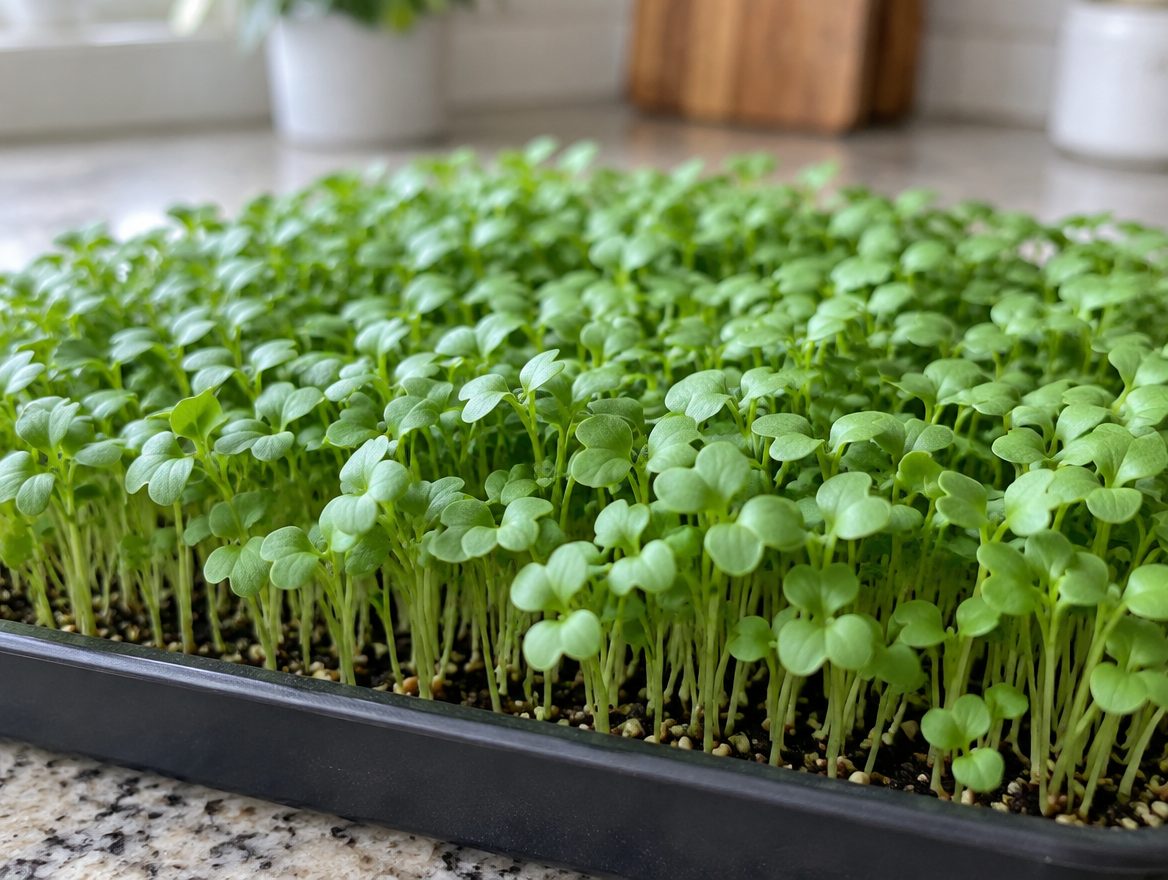
The easiest way to water microgreens is from the bottom: set the tray in shallow water until the medium is wet, then lift it out and let it drain. Penn State Extension recommends it “to limit the contact between water and the greens,” and Cornell Garden-Based Learning says microgreens respond well to bottom watering after sprouting. A spray bottle is the other common tool, used for dampening the medium before and during sprouting (Oregon State, Clemson). This guide covers both, with the moisture level to aim for and the airflow that keeps a tray fresh.
Bottom watering step by step
- Fill a tub or second tray with shallow water. Penn State says that for home use, trays can be placed in a tub with shallow water.
- Set the growing tray in the water. The drainage holes let the medium draw water up from below.
- Wait until the medium is wet. Penn State says to remove trays from the tub once the medium has been wetted.
- Lift the tray and let it drain. Penn State’s guidance is to allow drainage so there is no excess moisture.
- Return the tray to its spot. Back to the window or light shelf, with the greens kept dry from above.
Bottom watering keeps the water off the shoots and leaves, which is why Penn State recommends it. It also needs no special equipment: a tub, a baking tray or a second 1020 tray will do.
Spray bottle misting
Oregon State says to use a spray bottle to dampen the soil, and Clemson says to use a spray bottle to keep sprouting greens watered. Misting is handy in the first days, when the seed is sitting on top of the medium and you would like to avoid disturbing it. Mist until the surface is damp, and sprinkle lightly rather than pouring.
A good routine for many growers is to mist during germination and switch to bottom watering after sprouting, which matches Cornell’s note that bottom watering works well once seeds have sprouted.
Start with a damp medium
Moisture starts before sowing. Clemson says to moisten potting soil prior to filling containers, and Utah State says to pre-moisten coconut coir to the consistency and feel of a wrung-out sponge. A damp medium gives the seed what it needs on day one, and a cover during the blackout stage holds that moisture in (blackout method). For a mat, wet the mat in the tray and let excess drain.
How often to water
Penn State advises providing water only if necessary, avoiding excess moisture and allowing drainage. In practice that means checking the tray rather than following a calendar. The medium should be damp throughout the 7 to 21 day crop, and the tray should drain freely after each watering.
A damp medium at sowing, a cover during blackout and bottom watering after sprouting cover the whole cycle.
Clean water, every time
Penn State’s guidance is that water used for soaking, rinsing, irrigation and post-harvest washing should be clean, and it recommends regular cleaning schedules for trays, clippers and containers. For home growers, that is easy: fill the tub with fresh water each time you bottom water, and wash the tub and tray between crops. It is a quick habit that keeps each cycle starting well.
Soaking seed
Water also does a job before sowing. UMD says soaking certain seeds in water for 6 to 12 hours speeds germination, naming pea, sunflower, corn, chickpea, beet, chard, cilantro, mung bean and buckwheat. Penn State says seeds can be soaked overnight for 8 to 12 hours, especially large-seeded or hard-coated species such as pea and sunflower. Utah State lists 6 hours for pea shoots and 12 hours for sunflower, and no presoak for radish, broccoli, kale or arugula. Drain soaked seed before sowing it on the damp medium.
Airflow keeps trays fresh
Air movement is part of good watering. UMD suggests a gentle breeze from a nearby fan to keep air moving around the dense cluster of plants, and recommends venting any tray or container covers periodically so extra moisture does not build up. Penn State says that opening the window occasionally helps avoid excess moisture. A tray that is watered from below, drained and given fresh air stays crisp.
Temperature and light
Water works with warmth and light. Keep trays at about 68 to 75 F (UMD, Purdue, USU) and in a bright window or under 16 to 18 hours of light (grow lights for microgreens, microgreens on a windowsill). Keep trays away from HVAC vents and the temperature swings near windows, as Purdue advises.
Watering by medium
| Medium | Watering note | Source |
|---|---|---|
| Potting soil | Moisten before filling; spray bottle to dampen | Clemson, OSU |
| Coconut coir | Pre-moisten to a wrung-out-sponge feel | USU |
| Seeding or grow mat | Bottom water or mist; cleaner harvest | PSU |
| Soilless mix | Bottom watering until wet, then drain | PSU |
See growing medium for microgreens for choosing the medium.
Dry shoots at harvest
Because bottom watering keeps water off the shoots, the greens are dry and clean when you cut them. Read harvesting microgreens and storing microgreens for the full routine.
Water for the next tray
Each tray is one harvest, as microgreens do not regrow after cutting (OSU). Refill the tray with fresh medium, moisten it and sow again. Clemson and UMD both describe fresh medium, or a 50:50 mix of old and new, for the next batch. With bottom watering already part of your routine, a second and third tray is easy to add; see growing microgreens at home for the weekly rhythm, and how to grow microgreens for the whole method.
Frequently asked questions
How do you water microgreens?
Bottom watering is recommended by Penn State and Cornell: set the tray in shallow water until the medium is wet, then remove it and let it drain. A spray bottle also works (Oregon State, Clemson).
When should I start bottom watering?
Cornell says microgreens respond well to bottom watering after sprouting. Before then, mist or spray to keep the medium moist.
How often should I water?
Water when the tray needs it. Penn State advises providing water only as needed and allowing drainage, so the medium stays moist but not soggy.
Does airflow matter?
Yes. UMD suggests a gentle breeze from a fan and venting any tray covers now and then, and Penn State suggests opening a window occasionally.
Sources
- A step-by-step guide for growing microgreens at home, Penn State Extension
- Growing microgreens, Penn State Extension
- Growing microgreens, Seeds of Wonder lesson 1.5, Cornell Garden-Based Learning
- Microgreens add big flavor in a small footprint, Oregon State University Extension
- Growing microgreens, Clemson Home & Garden Information Center
- Grow your own microgreens, Utah State University Extension
- Growing microgreens and baby greens indoors, University of Maryland Extension