

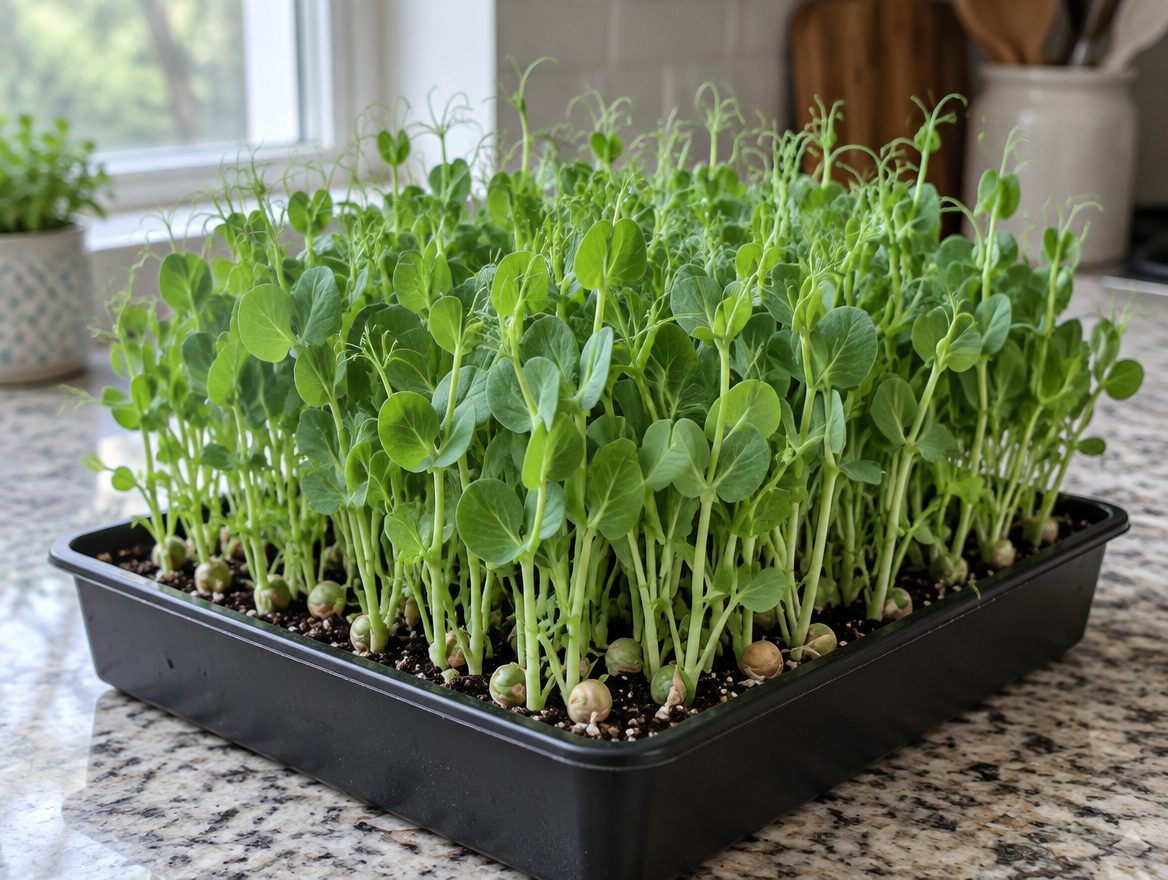
Pea shoots are one of the quickest and sweetest microgreens you can grow: sow a tray, keep it covered for about 3 days, and you can be cutting tender, sweet-tasting shoots in roughly 8 to 10 days. Utah State Extension’s chart gives the whole recipe: 150 g of seed per 10×20 inch tray, a 6-hour soak, 3 days covered, then light until harvest. They are a satisfying first tray because the seeds are big and easy to handle. It is also one of the picks in microgreens for beginners, and the fastest microgreens table shows how it compares on speed. New to the method? How to grow microgreens covers the steps every variety shares.
- Seed per 10×20 tray
- 150 g
- Soak
- 6–12 hours
- Blackout (covered)
- 3 days
- Germination
- Peas sprout in waves over 5–6 days
- Days to harvest
- 8–10 days
- Harvest at
- Two or more sets of true leaves
- Flavor
- Sweet pea
- Regrows
- No, start a new tray
Sowing pea shoots
Pea shoots use the most seed in Utah State Extension’s chart: 150 g per 10×20 inch tray, compared with 10 to 48 g for the other varieties it lists. Sow thickly and evenly, as Penn State and Maryland advise for all microgreens. Not sure how much to measure for a different tray? The seed calculator scales the sourced rate to any tray size.
Soaking is where peas shine. Utah State soaks pea seed for 6 hours, Penn State for about 10 hours, Maryland for 6 to 12 hours, and Oregon State suggests overnight for large seed such as peas and sunflower. Pick a time inside that window, drain, and sow right away. Mississippi State notes that soaking evens out germination, which matters with peas because a gray sugar pea variety was seen to sprout in waves over 5 or 6 days.
Penn State lists peat-based mixes, coconut coir and fiber mats as the common growing media for microgreens, and Maryland suggests a lightweight soilless mix. Start clean: choose seed sold for microgreens or marked untreated, wash your tray with soap and water, and use fresh water for soaking and rinsing.
Cover and blackout
Utah State keeps the tray in the dark for 3 days beneath a second 1020 tray, and a weight such as a piece of plywood keeps the seed pressed against the medium. For the second half of the dark period, it turns the top tray over so it forms a cover without touching the seeds. Penn State also recommends putting weight on pea and sunflower seed during germination.
Light and watering
Once the tray comes out of the dark, give it a bright window or a grow light. Utah State runs lights for 18 hours and dark for 6; Maryland recommends about 16 hours of total light a day, and Oregon State says a bright window works as well as fluorescent lights. For temperature, Maryland suggests 70 to 75°F, and Purdue points to 68 to 72°F away from heating vents and drafts.
Bottom watering keeps the shoots dry and tidy. Penn State suggests setting the tray in shallow water until the medium is wet, then lifting it out to drain. A gentle fan or an occasionally opened window keeps the air moving around the dense stand, as both Maryland and Penn State describe. See the harvest planner for a day-by-day schedule of sowing, uncovering and cutting.
Harvest
Utah State lists 8 to 10 days from sowing, Mississippi State lists 7 to 10 days and Clemson lists 10 to 15 days, so check your tray from about day 7 and let the shoots tell you. Purdue notes that most microgreens are cut at 2 to 4 inches with true leaves just emerging, while pea shoots are harvested taller, with two or more sets of true leaves. Cut the stems just above the medium with clean, sharp scissors, as Penn State and Purdue describe, and leave the roots behind.
Maryland and Oregon State both say microgreen seedlings do not regrow after cutting. Plan for a new tray each time, using fresh growing medium, and sow a second tray every few days if you want a steady supply (Oregon State suggests succession planting). Cold, dark storage helps your harvest last: Penn State reports 10 to 14 days at 41°F against 2 to 4 days at room conditions.
Flavor and color
Utah State and Clemson both describe the flavor as sweet, a fresh pea taste that works raw. Cut at the taller pea shoot stage, they bring a fresh green look to any plate.
How to use pea shoots
- Pile a handful on avocado toast, an open sandwich or a grain bowl.
- Toss them into a salad with a squeeze of lemon and a little olive oil.
- Fold them into warm pasta or fried rice at the very end so they stay crisp.
- Spoon them onto soup just before serving for a fresh, sweet finish.
- Use a small bunch as a garnish for eggs, fish or roast vegetables.
Looking for something faster to follow up? Radish microgreens are ready on a similar timeline, while sunflower microgreens share the soak-and-weight routine.
What’s in it
Second highest vitamin C of six microgreen species tested in a 2024 open-access study.
- Vitamin C (ascorbic acid)second of six species
- 70.76 mg
In the same study bean microgreens measured 80.45 mg per 100 g fresh weight and sunflower microgreens 67.55 mg, which puts pea shoots in good company at the top of the list. See microgreens nutrition for how these figures fit the wider USDA studies.
Plan your tray
Plan your harvest
Frequently asked questions
How long do pea shoots take to grow?
Utah State Extension lists 8 to 10 days for pea shoots, Mississippi State lists 7 to 10 days and Clemson lists 10 to 15 days. Most home trays land in the first half of that span, and you can use the planner on this page to see your own dates.
Do I need to soak pea seeds?
Soaking is the standard step for peas. Utah State soaks for 6 hours, Penn State for about 10 hours, Maryland says 6 to 12 hours and Oregon State says overnight. Any time inside that window speeds up even sprouting.
How much seed does a pea shoot tray need?
Utah State uses 150 g of seed for a standard 10×20 inch tray. Peas are a large seed, so this is the heaviest seed rate of the common varieties, and the seed calculator on this site scales it to other tray sizes.
Why are pea shoots cut taller than other microgreens?
Purdue Extension notes that most crops are cut at 2 to 4 inches with the first true leaves just showing, while pea shoots are harvested taller, once they carry two or more sets of true leaves.
Will pea shoots grow back after cutting?
Maryland and Oregon State both say microgreen seedlings do not regrow after cutting, so the simple routine is to compost the roots and start a fresh tray with fresh growing medium.
Sources
- Grow Your Own Microgreens, Utah State University Extension
- Growing Microgreens and Baby Greens Indoors, University of Maryland Extension
- A Step-by-Step Guide for Growing Microgreens at Home, Penn State Extension
- Grow Microgreens at Home, Purdue Extension
- Growing Microgreens for the Mississippi Gardener, Mississippi State University Extension
- Growing Microgreens, Clemson Cooperative Extension, Home and Garden Information Center
- Microgreens, Oregon State University Extension
- Nutrient composition of six microgreen species (open-access study, 2024), PubMed Central
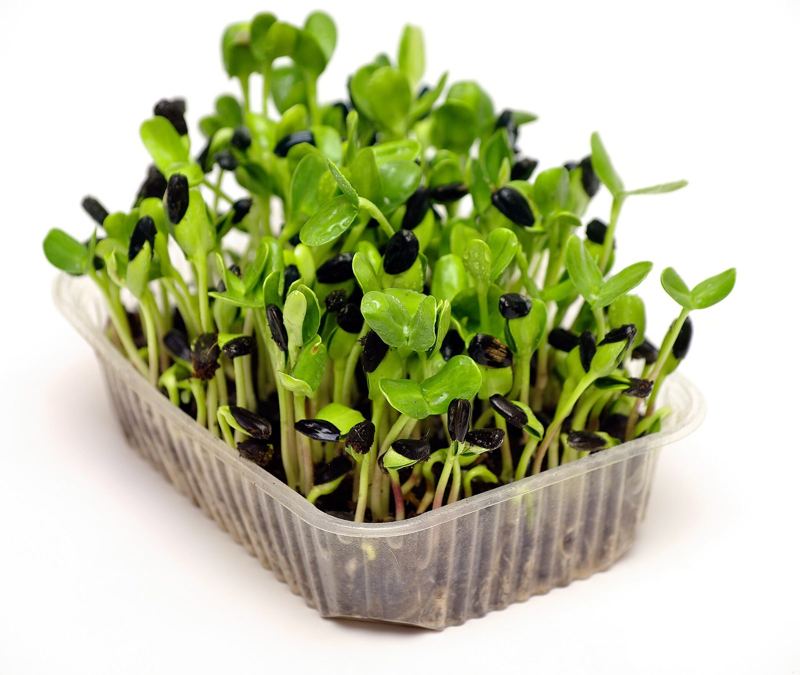 Sunflower
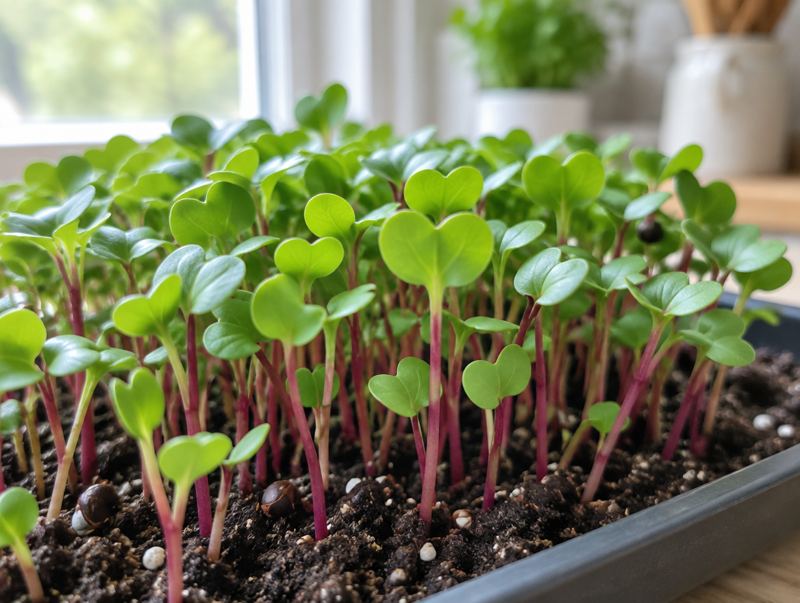 Radish
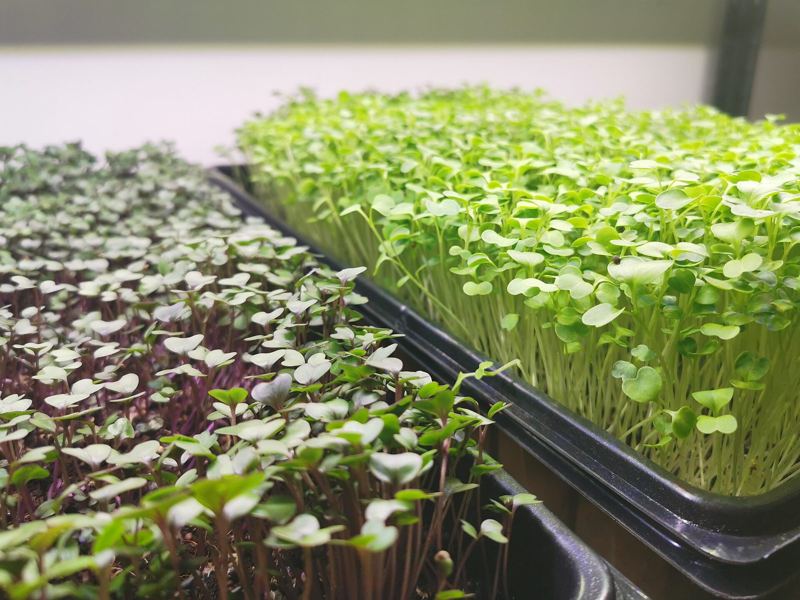 Broccoli