
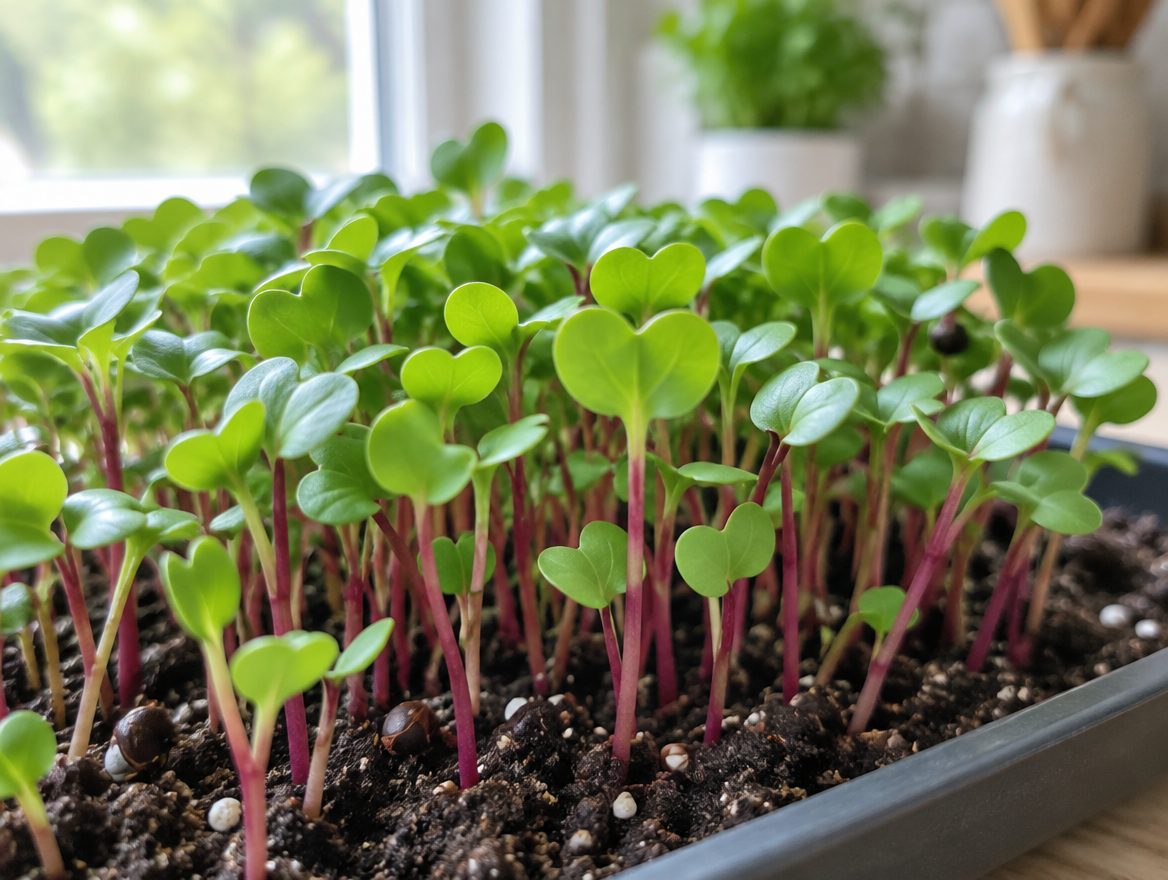
Radish microgreens are fast, bold and easy: sow 42 g of seed per 10×20 inch tray, skip the soak, keep it covered for only 1 to 2 days, and you can be cutting a nutty, spicy harvest in about 8 to 12 days. Utah State Extension lists that recipe, and Virginia Tech and Mississippi State report even quicker harvests, from 6 to 10 days. For a spicy flavor with so little waiting, radish is hard to beat. It is also one of the picks in microgreens for beginners, and the fastest microgreens table shows how it compares on speed. New to the method? How to grow microgreens covers the steps every variety shares.
- Seed per 10×20 tray
- 42 g
- Soak
- No soak needed
- Blackout (covered)
- 1–2 days
- Germination
- About 36 hours at 72°F (cabbage family)
- Days to harvest
- 8–12 days
- Harvest at
- 2–3 inches tall, first true leaves forming
- Flavor
- Nutty, spicy
- Color
- Purple cultivar available
- Regrows
- No, start a new tray
Sowing radish microgreens
Utah State’s chart lists 42 g of radish seed for a 10×20 inch tray, with no presoak. Mississippi State gives the same job in tablespoons: 2 to 3 tablespoons for that tray size. Scatter the seed thickly and evenly over a pre-moistened medium, as Penn State and Maryland advise for all microgreens. The seed calculator scales the gram figure to your tray size.
Radish takes happily to a mat. Virginia Tech lists hemp and burlap grow mats for radish microgreens, and Penn State names peat-based mixes, coconut coir and fiber mats as the common media. A good start makes the whole tray easier: seed labeled for microgreens or untreated (Clemson), a tray washed with soap and water, and fresh water for each watering.
Cover and blackout
Radish needs the shortest covered start in Utah State’s chart, just 1 to 2 days. The cabbage family germinates quickly, about 36 hours at 72°F according to Maryland, so check the tray after a day. Cover with a second tray, a clear lid or plastic to trap warmth and moisture (Clemson, Maryland), then move to the light when the sprouts are up.
Light and watering
Natural window light or grow lights both work. Utah State suggests 18 hours of light and 6 hours of dark, Maryland about 16 hours total, and Oregon State says a bright window does the job as well as fluorescent lights. Maryland recommends 70 to 75°F. Water from the bottom by setting the tray in a shallow tub until the medium is damp (Penn State) and keep the air moving with a gentle fan (Maryland). The harvest planner turns your sow date into uncover and cut dates.
Harvest
Utah State lists 8 to 12 days, Virginia Tech 6 to 10 days and Mississippi State 7 to 10 days, grouped with pea shoots as the quickest crops in its list. Maryland’s general size guide is 2 to 3 inches tall, 7 to 21 days after sowing. Cut just above the medium with clean, sharp scissors (Penn State). Radish microgreens do not regrow after cutting (Maryland, Oregon State), so the next tray gets fresh medium. For a steady supply, Oregon State suggests starting just enough for the household and sowing more every few days. Cold, dark storage at 41°F extends shelf life to 10 to 14 days (Penn State).
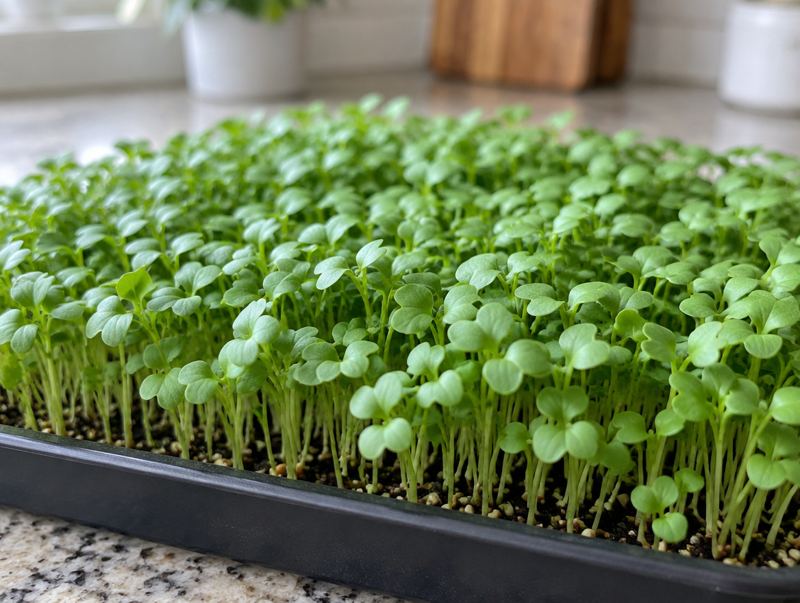
Arugula is the quickest variety in Utah State’s chart, with a 6 to 8 day listing.
Flavor and color
Utah State lists radish as nutty and spicy, and Oregon State recommends radish and mustard for a spicy kick. Both Utah State and Penn State list a purple radish cultivar, so a colorful tray is possible if you buy seed for it. Fresh radish microgreens add a peppery punch to anything that is plain.
How to use radish microgreens
- Scatter over tacos, noodle bowls or a fried egg for a peppery finish.
- Layer into sandwiches and wraps for a spicy crunch.
- Toss with sweeter pea shoots to balance the heat.
- Add to a cold salad of cucumber or avocado.
- Use as a garnish on soup just before serving.
Keep the supply going
Because a radish tray is ready so quickly, it suits succession planting: Oregon State suggests starting just enough for the household to eat and planting more every few days, so there is always a tray coming along. Maryland and Oregon State both note that a bright window or grow lights let you keep growing indoors through the year. Between rounds, empty the tray, wash it with soap and water and refill with fresh medium, which Penn State recommends for each production cycle. Store the cut greens in a clean plastic bag in the refrigerator (Clemson) and rinse them just before eating, as Penn State advises.
What’s in it
Radish shows up across the USDA ARS microgreen studies, with high vitamin E in two different varieties.
- Vitamin C, black radishsix-species study
- 33.37 mg
- Vitamin E, green daikon radishtocopherols, USDA ARS
- Highest of 25
- Vitamin E, red radishBrassicaceae, USDA ARS
- Highest of 30
See microgreens nutrition for how these figures fit the wider USDA studies.
Plan your tray
Plan your harvest
Frequently asked questions
How long do radish microgreens take to grow?
Utah State lists 8 to 12 days, Virginia Tech 6 to 10 days and Mississippi State 7 to 10 days. That puts radish among the faster varieties, and the planner on this page shows your own dates.
Do radish seeds need to be soaked?
No. Utah State's chart marks radish as a no-soak seed.
How much radish seed goes in a tray?
Utah State lists 42 g for a 10×20 inch tray (purple radish), and Mississippi State puts it at 2 to 3 tablespoons for a tray of that size. The seed calculator on this site scales the gram figure.
What do radish microgreens taste like?
Utah State describes them as nutty and spicy, and Oregon State recommends radish for a spicy kick.
How long do I keep the tray covered?
Utah State covers radish for 1 to 2 days, one of the shortest covered periods in its chart, and Maryland reports that cabbage-family seed germinates in about 36 hours at 72°F.
Sources
- Grow Your Own Microgreens, Utah State University Extension
- Growing Microgreens for the Mississippi Gardener, Mississippi State University Extension
- Microgreen Production (SPES-756), Virginia Tech Cooperative Extension
- Growing Microgreens and Baby Greens Indoors, University of Maryland Extension
- Microgreens, Oregon State University Extension
- A Step-by-Step Guide for Growing Microgreens at Home, Penn State Extension
- Assessment of vitamin and carotenoid concentrations of 25 commercial microgreens, USDA Agricultural Research Service
- Vitamin and carotenoid concentrations of 30 Brassicaceae microgreens, USDA Agricultural Research Service
- Nutrient composition of six microgreen species (open-access study, 2024), PubMed Central
 Arugula
 Broccoli
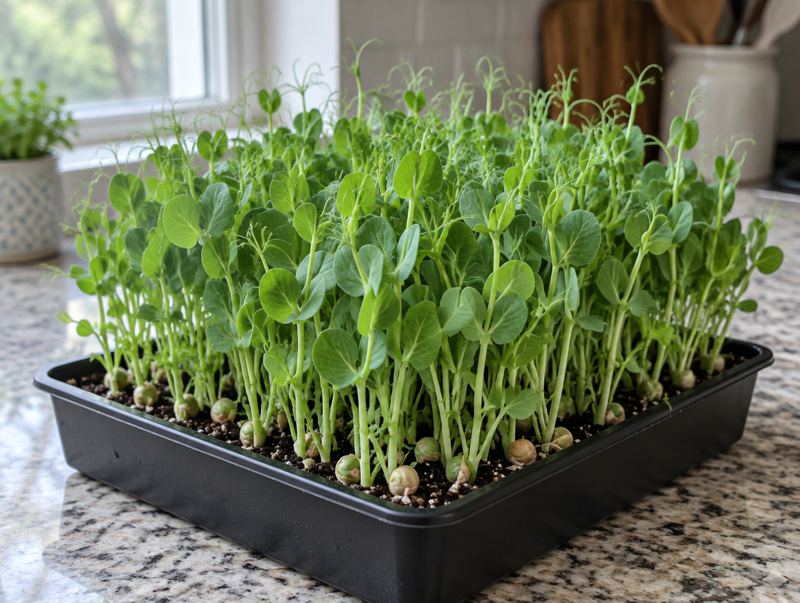 Pea Shoots