
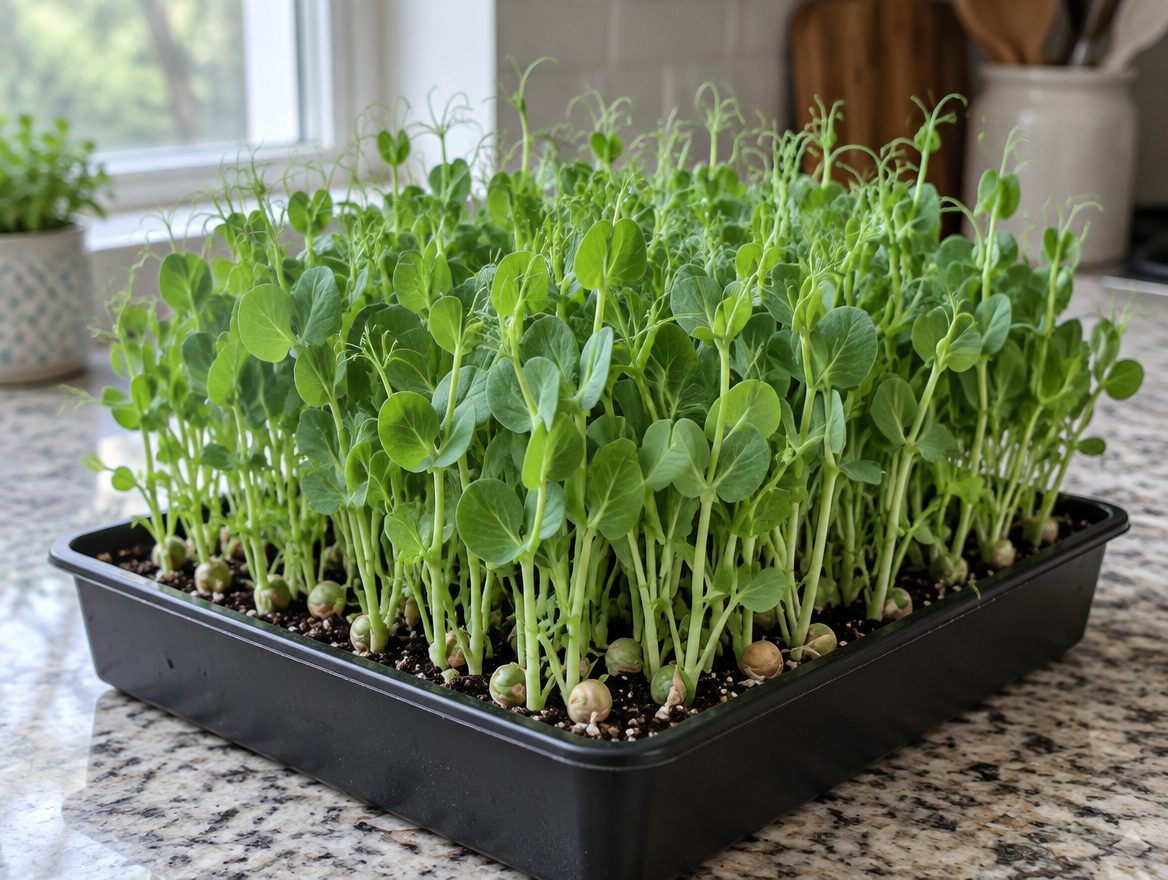
The best growing medium for microgreens is a lightweight one: a soilless seed-starting mix, pre-moistened coconut coir or a seeding mat all work well, and moistened potting soil is another option. The University of Maryland Extension says to “use any lightweight soilless mix in the container or tray,” Utah State Extension names seed-starting mix, coconut coir and hydroponic grow mats, and Penn State Extension describes soilless potting media and seeding mats. Microgreens are cut within 7 to 21 days, so a shallow layer of an even, damp medium is all the tray needs.
Medium options compared
| Medium | What sources say | Source |
|---|---|---|
| Soilless seed-starting or potting mix | Lightweight mix in trays; 1020 and 10- or 20-row trays are filled with soilless media | UMD, USU, PSU |
| Coconut coir | Pre-moisten to the feel of a wrung-out sponge | USU |
| Hydroponic grow mat or seeding mat | Harvested microgreens are cleaner than from potting soil | USU, PSU |
| Potting soil | Moisten it before filling containers | Oregon State, Clemson |
| Peat-based mixes | A common medium | PSU |
Penn State’s summary of the common media is “peat-based mixes, coconut coir and fiber mats,” and Virginia Tech describes hemp and burlap grow mats for broccoli and radish microgreens.
Why lightweight media suit microgreens
A microgreen crop is short, and the seed is spread thickly (UMD). UMD describes garden soil from the ground as too dense for growing microgreens and baby greens in containers, which is why lighter media are the usual pick.
Choosing the right one
- A seed-starting mix is a familiar, widely available choice. Moisten it, level it and sow.
- Coconut coir holds moisture and is easy to pre-moisten. Utah State says it should feel like a wrung-out sponge.
- A seeding or grow mat is tidy and gives a clean cut. Penn State notes the harvest is cleaner than from potting soil.
- Potting soil is the option Oregon State and Clemson describe. Clemson says to moisten it before filling the containers.
If you prefer to skip soil entirely, microgreens without soil goes through coir, mats and soilless mixes step by step.
Filling the tray
- Start with a clean tray. Shallow, with drainage holes, food-suitable (PSU). Wash recycled containers with soap and water (Clemson).
- Moisten the medium before filling (Clemson, USU).
- Fill evenly to a shallow depth and level the surface.
- Sow thickly and evenly. Penn State’s rate is 10 to 15 g per standard 12 x 20 inch tray, and general density runs from 2 seeds per square inch for large seed to 12 for small seed.
- Leave the seed uncovered if you like. Penn State says covering seed with medium is not necessary, and it could be better not to so the sprouts stay clean. Alternatively, cover the tray itself with a lid or a second tray for the blackout stage (blackout method).
Medium and watering
Whatever you choose, water is added so the medium is wet but drains. Penn State and Cornell recommend bottom watering: set the tray in shallow water until the medium is wet, then remove it. Spray bottles work too (Oregon State, Clemson). Keep the medium evenly damp and allow drainage (PSU), and let air move through the room with a gentle breeze from a fan (UMD).
Fresh medium for each tray
Microgreens do not regrow after cutting (OSU), so each tray ends at harvest. Then start the next tray in fresh medium: Clemson says to refill containers with fresh media and sow new seed, and Penn State says new medium for each production cycle gives the best start, though you can reuse it. UMD suggests planting the next batch in fresh medium or mixing old and new medium 50:50.
Matching medium to variety
Variety guidance is simple because the media are shared. Penn State lists the same common media for all microgreens, and Utah State’s per-variety data covers seed amount, soak, covered days and days to harvest on a standard tray:
| Variety | Seed per 10 x 20 tray | Days to harvest |
|---|---|---|
| Arugula | 10 g | 6 to 8 |
| Broccoli and kale | 28 g | 8 to 12 |
| Radish | 42 g | 8 to 12 |
| Sunflower | 48 g | 9 to 10 |
| Pea shoots | 150 g | 8 to 10 |
Source: Utah State University Extension. Larger seed such as pea and sunflower is the one to soak, for 6 to 12 hours, to even out germination (UMD, USU).
Quick choices by situation
- Windowsill with a small tray. A seed-starting mix or coir, level and damp (microgreens on a windowsill).
- Cleanest harvest. A seeding mat.
- What is already in the cupboard. Moistened potting soil, as Oregon State and Clemson describe.
Trays that pair well with each medium
Penn State describes 1020 greenhouse trays and 10- or 20-row seedling trays filled with soilless media, and Utah State adds pie tins and takeout trays. Whatever the container, a shallow layer is enough, drainage holes let extra water leave, and the medium is leveled before sowing so the seed spreads evenly. Mats cut to fit the tray also keep the surface flat.
Next steps
With a medium picked, the rest of the method follows. See how to grow microgreens for the full walkthrough and growing microgreens at home for the complete supplies list. The seed calculator gives the seed amount for your tray, and the harvest planner turns the sow date into a cut date.
Frequently asked questions
What is the best growing medium for microgreens?
Extension guides name several good choices: a lightweight soilless mix (UMD), seed-starting mix, coconut coir or a hydroponic grow mat (USU), and seeding mats (PSU). Oregon State and Clemson also describe moistened potting soil.
Can I use garden soil?
UMD recommends lighter media for trays, because garden soil is too dense for growing microgreens indoors in containers.
Should I moisten the medium first?
Yes. Clemson says to moisten potting soil before filling containers, and USU says to pre-moisten coir to a wrung-out-sponge feel.
Can I reuse the medium?
Penn State says you can, but fresh medium for each production cycle gives the best start. UMD suggests fresh medium or a 50:50 mix of old and new.
Sources
- Growing microgreens and baby greens indoors, University of Maryland Extension
- Grow your own microgreens, Utah State University Extension
- Growing microgreens, Penn State Extension
- Microgreens add big flavor in a small footprint, Oregon State University Extension
- Growing microgreens, Clemson Home & Garden Information Center
- A step-by-step guide for growing microgreens at home, Penn State Extension
- Microgreen production, SPES-756, Virginia Cooperative Extension
- Growing microgreens, Seeds of Wonder lesson 1.5, Cornell Garden-Based Learning