
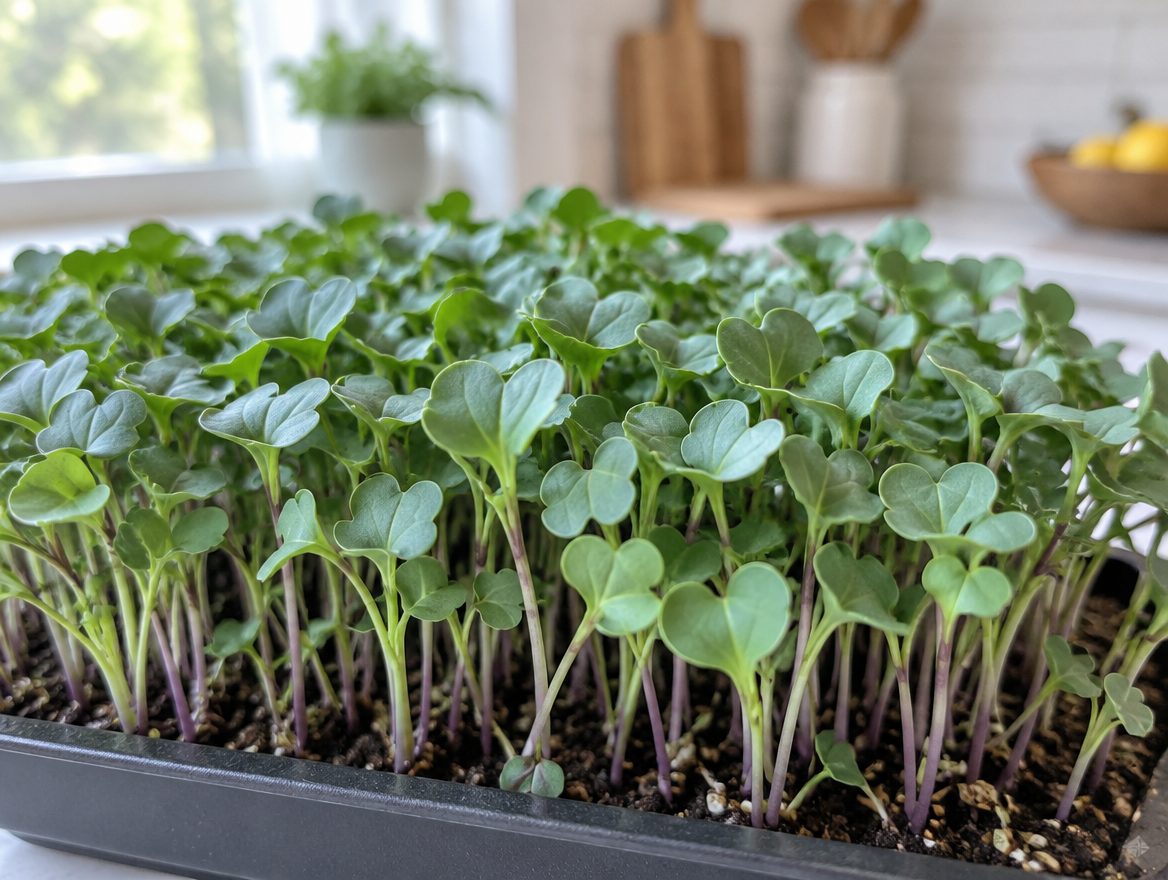
Kale microgreens are an easy, savory tray: sow 28 g of seed per 10×20 inch tray, skip the soak, keep it covered for 1 to 2 days, and cut in about 8 to 12 days. Utah State Extension’s chart lists that recipe, while Virginia Tech, Clemson and Mississippi State report ranges that run from 8 to 15 days. The flavor is nutty and earthy, which makes kale microgreens a friendly choice for anyone who likes the full-grown vegetable. It is also one of the picks in microgreens for beginners, and the fastest microgreens table shows how it compares on speed. New to the method? How to grow microgreens covers the steps every variety shares.
- Seed per 10×20 tray
- 28 g
- Soak
- No soak needed
- Blackout (covered)
- 1–2 days
- Germination
- About 36 hours at 72°F (cabbage family)
- Days to harvest
- 8–12 days
- Harvest at
- 2–3 inches tall, first true leaves forming
- Flavor
- Nutty, earthy brassica
- Regrows
- No, start a new tray
Sowing kale microgreens
Utah State lists 28 g of kale seed for a standard 10×20 inch tray, with no presoak. Sow the seed thickly and evenly over a moist medium. Penn State’s general rules are a denser sowing than for a full-size crop, and lower rates in summer than in winter. If your tray is a different size, the seed calculator scales the figure.
Penn State names peat-based mixes, coconut coir and fiber mats as the usual media, and Maryland suggests a lightweight soilless mix. It is a good habit to begin each tray cleanly: seed labeled for microgreens or untreated (Clemson), a tray washed with soap and water, and fresh water.
Cover and blackout
Kale spends only 1 to 2 days covered in Utah State’s chart, the same short start as radish and arugula. Maryland reports about 36 hours to germination at 72°F for the cabbage family, so the seeds get going fast. Cover the tray with a second tray, lid or plastic to keep warmth and moisture in (Clemson, Maryland), then move it to the light when the sprouts are up.
Light and watering
Utah State runs lights 18 hours with 6 hours of dark, and Maryland suggests about 16 hours in total. A bright window works as well as fluorescent lights, according to Oregon State. Maryland recommends 70 to 75°F, and Purdue suggests 68 to 72°F away from heating vents and drafts. Water from the bottom with a shallow tub until the medium is damp, then drain (Penn State). A gentle fan keeps air moving (Maryland). The harvest planner turns your sow date into an uncover date and harvest window.
Harvest
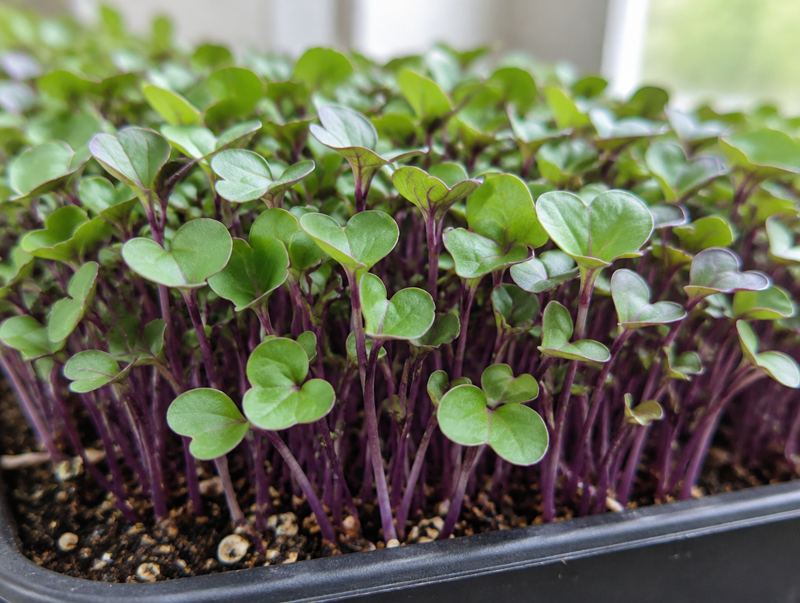
Sources give a range: Utah State 8 to 12 days, Virginia Tech 8 to 14 days, Clemson 10 to 15 days and Mississippi State 10 to 15 days (where kale is grouped with mustard, red cabbage, kohlrabi and arugula). Maryland’s general size guide is 2 to 3 inches tall, 7 to 21 days after sowing, and Purdue and Utah State say to cut when the first true leaves appear. Cut just above the medium with clean scissors and leave the roots (Penn State). Seedlings do not regrow after cutting (Maryland, Oregon State), so sow the next tray in fresh medium. Store the harvest in a clean plastic bag in the refrigerator (Clemson). Penn State reports that dark storage at 41°F gives 10 to 14 days of shelf life.
Flavor and color
Utah State lists kale as a strong brassica, nutty flavor and Clemson lists it as mild and earthy. Virginia Tech’s summary of flavor research describes brassica microgreens as more neutral than peppery arugula. The overlap is a pleasant, savory green with a nutty finish. It sits between mild broccoli microgreens and spicier mustard microgreens.
How to use kale microgreens
- Toss into a salad with citrus, seeds and a mustard vinaigrette.
- Top a bowl of grains, roasted squash or soup.
- Fold into an omelet or frittata just before it sets.
- Layer onto sandwiches and wraps.
- Add to a smoothie bowl or blend into a green dressing.
For more ideas, see how to eat microgreens.
Trays and containers
Any shallow, clean, food-suitable tray with drainage holes works, as Penn State describes. Utah State lists standard 1020 trays, 10- or 20-row seed trays, pie tins and takeout containers, and Oregon State notes that drainage holes can be punched with a nail. Wash recycled containers with soap and water (Clemson).
Keep the supply going
Kale pairs well with other brassicas on a shared schedule. Because several of them share a short covered period of 1 to 2 days (radish, arugula and kale in Utah State’s chart), you can sow them the same day and uncover them together. Oregon State suggests succession planting, starting just enough for the household and planting more every few days. Refill with fresh medium after each cut (Penn State), and rinse the greens just before eating.
Plan your tray
Plan your harvest
Frequently asked questions
How long do kale microgreens take to grow?
Utah State lists 8 to 12 days, Virginia Tech 8 to 14 days, and Clemson and Mississippi State 10 to 15 days. Start checking the tray around day 8.
How much kale seed goes in a tray?
Utah State uses 28 g of seed per 10×20 inch tray. The seed calculator on this site scales it to other tray sizes.
Do kale seeds need soaking?
No. Utah State's chart marks kale as a no-soak seed.
What do kale microgreens taste like?
Utah State describes a strong brassica, nutty flavor, and Clemson lists them as mild and earthy. Both are friendly, savory flavors that suit salads and cooked dishes.
How long do I keep kale covered?
Utah State covers kale for 1 to 2 days, and Maryland reports that cabbage-family seed germinates in about 36 hours at 72°F.
Sources
- Grow Your Own Microgreens, Utah State University Extension
- Microgreen Production (SPES-756), Virginia Tech Cooperative Extension
- Growing Microgreens, Clemson Cooperative Extension, Home and Garden Information Center
- Growing Microgreens for the Mississippi Gardener, Mississippi State University Extension
- Growing Microgreens and Baby Greens Indoors, University of Maryland Extension
- A Step-by-Step Guide for Growing Microgreens at Home, Penn State Extension
- Growing Microgreens, Penn State Extension
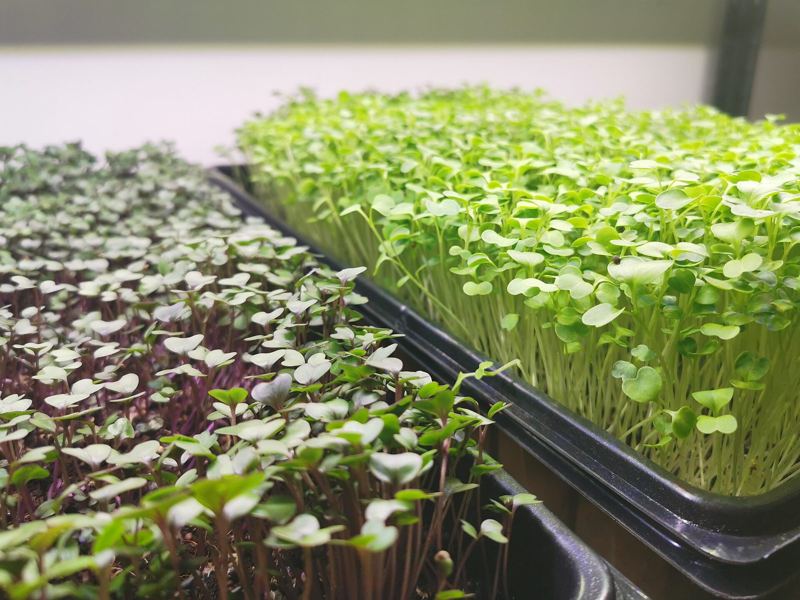 Broccoli
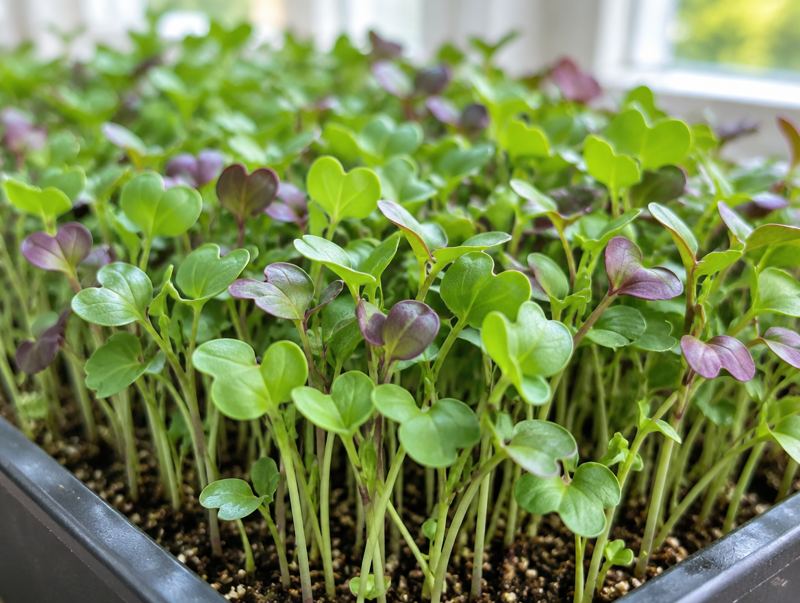 Mustard
 Kohlrabi