
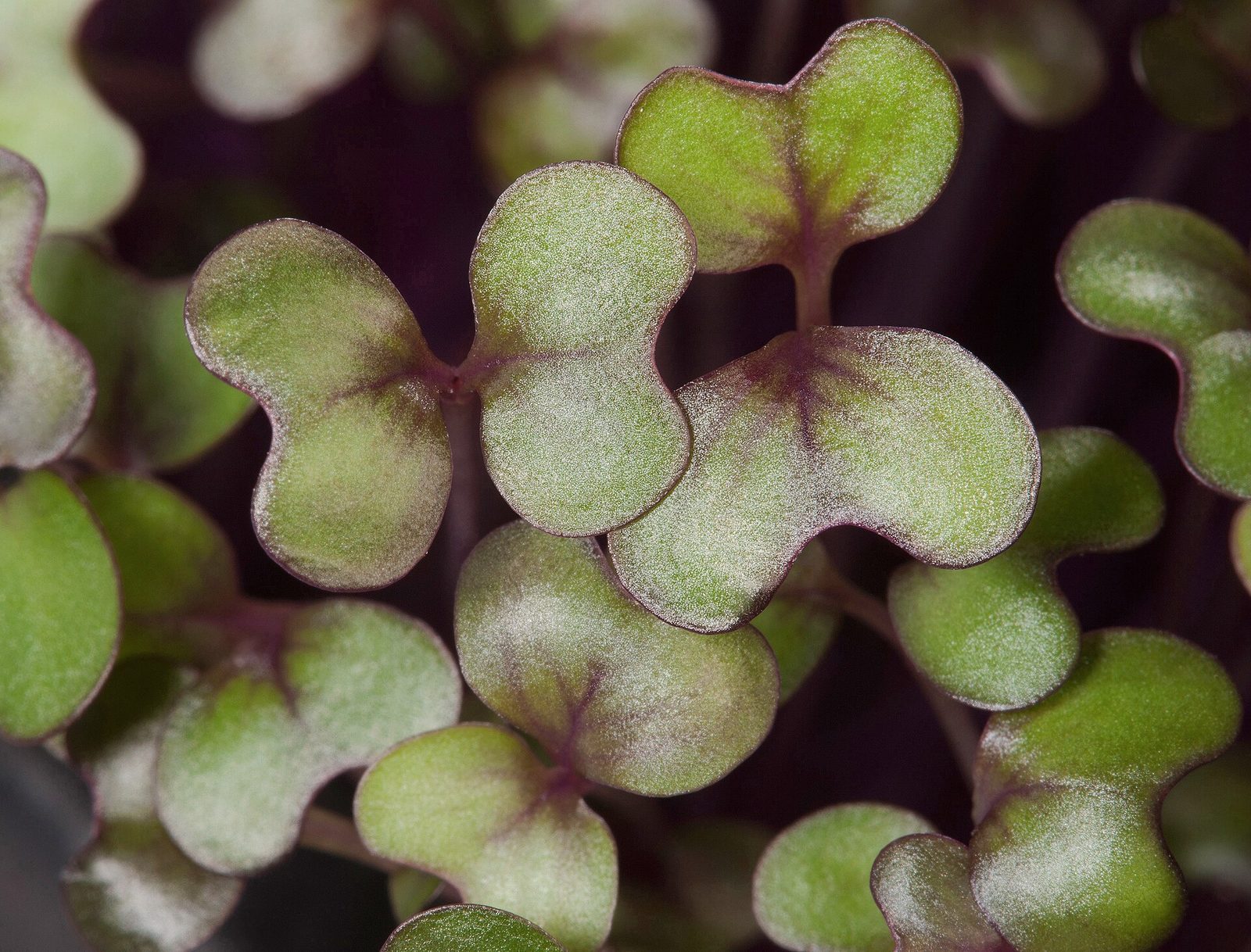
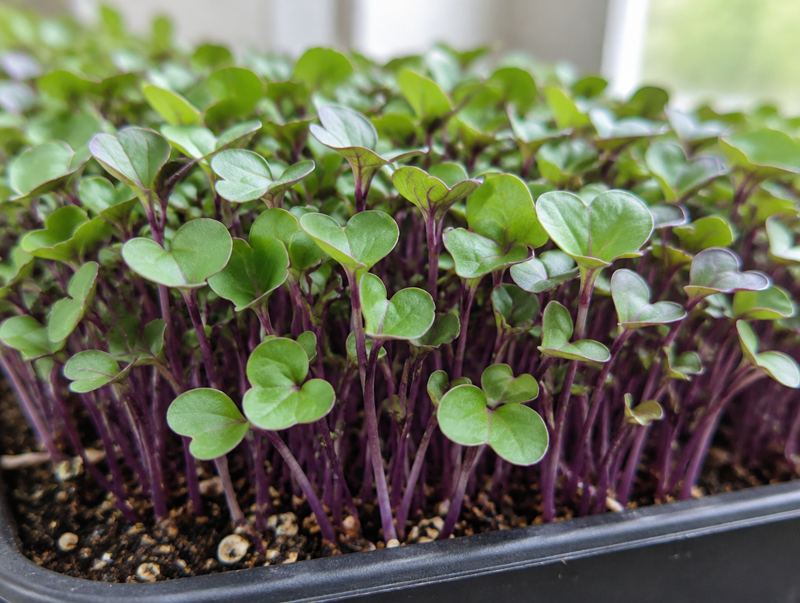
Red cabbage microgreens are a vibrant, easy-to-grow tray that finishes in about 10 to 15 days, and they hold a headline from a USDA study: the highest vitamin C of the 25 commercial microgreens tested. Mississippi State Extension lists 2 to 3 teaspoons of seed per 10×20 inch tray and a 10 to 15 day harvest. The cabbage family sprouts quickly, so the tray fills in fast. The fastest microgreens table shows how its timing compares. New to the method? How to grow microgreens covers the steps every variety shares.
- Seed per 10×20 tray
- 2–3 teaspoons
- Germination
- About 36 hours at 72°F (cabbage family)
- Days to harvest
- 10–15 days
- Harvest at
- 2–3 inches tall, first true leaves forming
- Regrows
- No, start a new tray
Sowing red cabbage microgreens
Mississippi State Extension lists 2 to 3 teaspoons of red cabbage seed for a 10×20 inch tray. Spread it thickly and evenly over a pre-moistened medium. Penn State’s general guidance is to sow microgreens more densely than a crop grown to full size, with lower rates in summer than in winter. Because the sourced rate is in teaspoons, measure it out with a standard teaspoon and level the seed across the tray. The seed calculator covers the varieties that have a sourced rate in grams.
For the medium, Penn State names peat-based mixes, coconut coir and fiber mats, and Maryland suggests a lightweight soilless mix. Begin clean: seed sold for microgreens or marked untreated (Clemson), a tray washed with soap and water, and fresh water for each watering.
Cover and blackout
The cabbage family is quick to germinate, about 36 hours at 72°F according to Maryland. Start the tray under a cover that traps warmth and moisture, such as a second tray, a lid or clear plastic (Clemson, Maryland), and uncover once the stems are up. Penn State suggests keeping seeds in the dark for a few days to help germination. Look at the tray every day: with brassicas, a lot happens in the first two days.
Light and watering
Use a bright window or a grow light. Utah State’s chart for other varieties runs 18 hours of light and 6 hours of dark, and Maryland suggests about 16 hours in total. Maryland recommends 70 to 75°F. Water from the bottom by setting the tray in a shallow tub until the medium is damp, then draining it (Penn State), and keep air moving with a small fan or an open window (Maryland, Penn State). The harvest planner gives you the dates once you enter your sow day.
Harvest
Mississippi State lists 10 to 15 days, grouped with mustard, kale, kohlrabi and arugula. Maryland’s general guide is 2 to 3 inches tall, and Purdue and Utah State say to cut when the first true leaves show. Cut just above the medium with clean scissors, leaving the roots behind (Penn State). Seedlings do not regrow (Maryland, Oregon State), so the next tray gets fresh medium. Penn State’s grower table lists red cabbage at 106.1 g (0.23 lb) per tray. Store the harvest in a clean plastic bag in the refrigerator (Clemson); Penn State reports 10 to 14 days at 41°F in the dark.
Flavor and color
Virginia Tech’s summary of flavor research describes brassica microgreens as more neutral in flavor than peppery arugula, so red cabbage is a gentle green that goes with most dishes. Its main appeal is the look it brings to the plate. Pair it with broccoli microgreens for a two-tone tray, or with kale for a heartier salad base.
How to use red cabbage microgreens
- Scatter over tacos, slaw or a rice bowl for a splash of color.
- Layer into sandwiches and wraps.
- Top a salad of citrus and avocado.
- Add to soup or noodle dishes just before serving.
- Garnish roast vegetables or a plate of eggs.
Keep the supply going
Start just enough for the household and plant more every few days, as Oregon State suggests, so a fresh tray is always on its way. Use a shallow, clean, food-suitable tray with drainage holes (Penn State) and fresh medium for each round. Maryland and Oregon State both note that a bright window or grow lights keep production going indoors through the year.
What’s in it
Red cabbage had the highest vitamin C (ascorbic acid) of the 25 commercial microgreens in a USDA Agricultural Research Service study.
- Vitamin C (ascorbic acid)ranking
- Highest of 25
- Vitamin C across all 25range
- 20.4–147.0 mg
See microgreens nutrition for how these figures fit the wider USDA studies.
Plan your tray
Plan your harvest
Frequently asked questions
How long do red cabbage microgreens take to grow?
Mississippi State lists 10 to 15 days. Maryland's general guide for microgreens is 2 to 3 inches tall, 7 to 21 days after sowing.
How much red cabbage seed goes in a tray?
Mississippi State gives 2 to 3 teaspoons of seed for a 10×20 inch tray. Sow it thickly and evenly over a moist medium.
Which microgreen has the most vitamin C?
In a USDA Agricultural Research Service study of 25 commercial microgreens, red cabbage had the highest vitamin C (ascorbic acid) concentration. Across the 25, totals ranged from 20.4 to 147.0 mg per 100 g of fresh weight.
How long does red cabbage take to germinate?
Maryland reports about 36 hours at 72°F for cabbage-family seed, so you should see sprouts quickly.
Can I grow red cabbage on a mat?
Yes. Penn State lists coconut coir and fiber mats among the common media for microgreens, and Virginia Tech lists hemp and burlap mats for brassicas such as broccoli and radish.
Sources
- Growing Microgreens for the Mississippi Gardener, Mississippi State University Extension
- Growing Microgreens and Baby Greens Indoors, University of Maryland Extension
- A Step-by-Step Guide for Growing Microgreens at Home, Penn State Extension
- Growing Microgreens, Penn State Extension
- Assessment of vitamin and carotenoid concentrations of 25 commercial microgreens, USDA Agricultural Research Service
- Microgreen Production (SPES-756), Virginia Tech Cooperative Extension
- Growing Microgreens, Clemson Cooperative Extension, Home and Garden Information Center
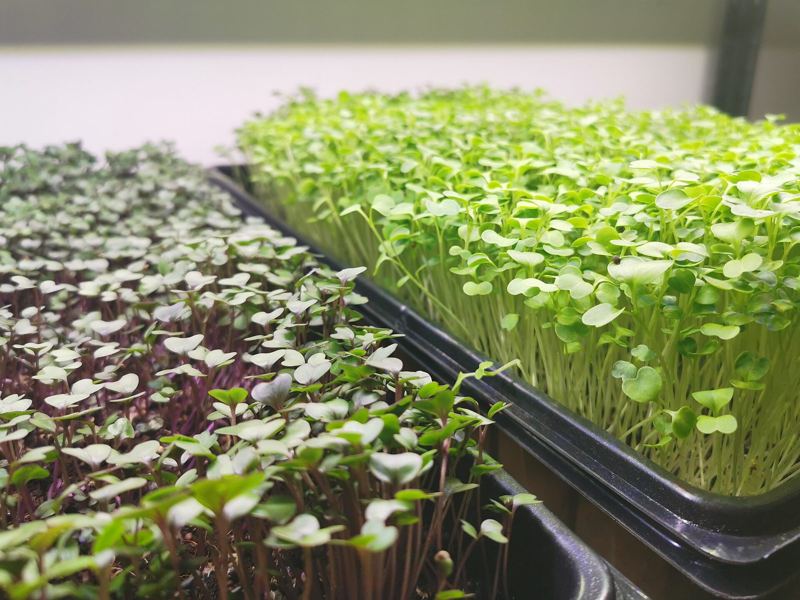 Broccoli
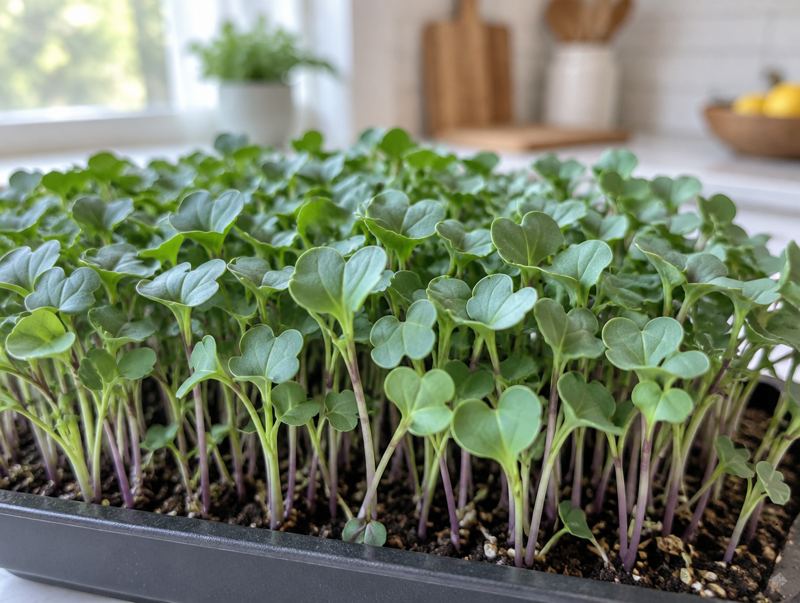 Kale
 Kohlrabi