

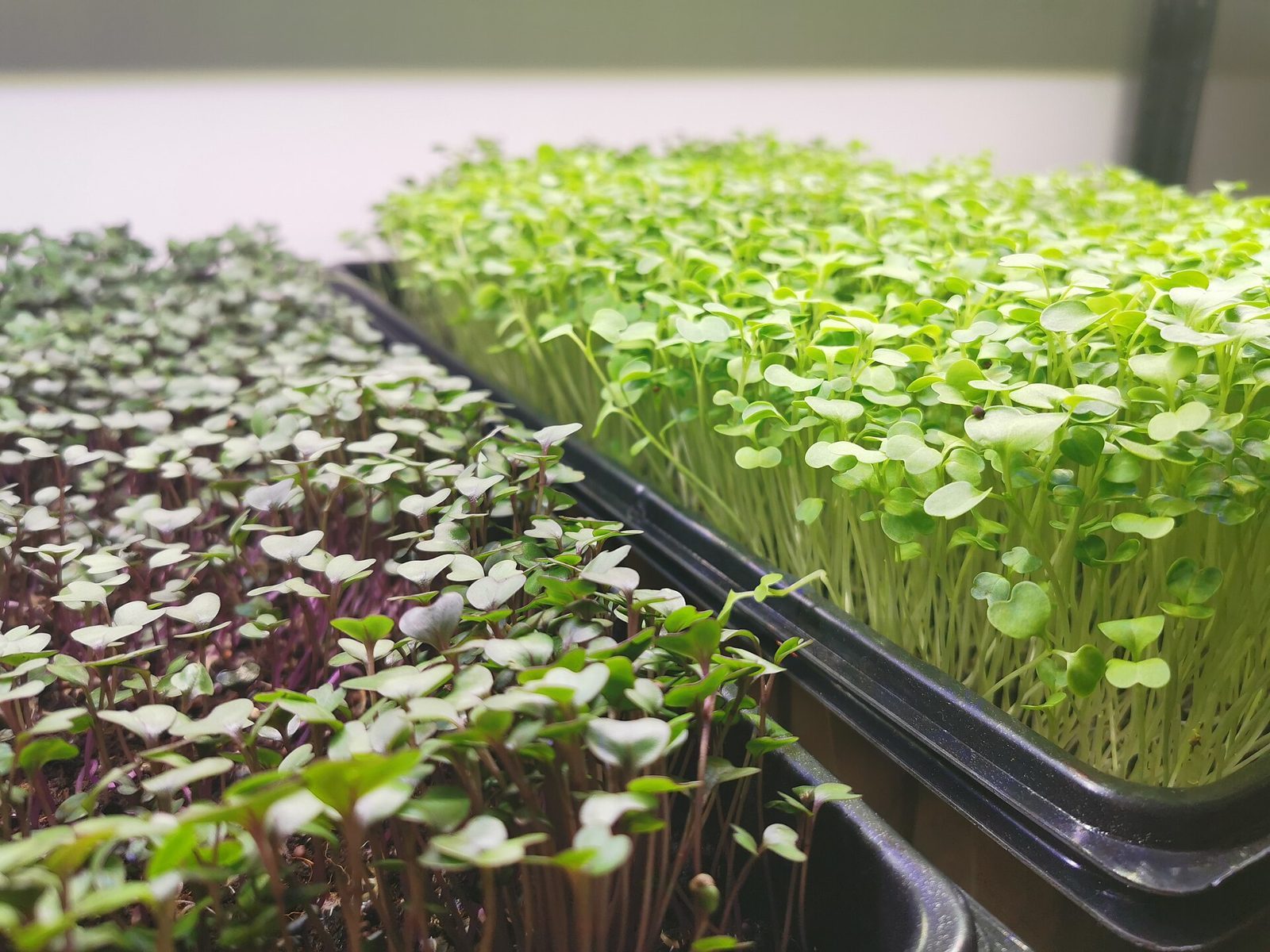
There is no single most nutrient dense microgreen: the leader changes with the nutrient. In a USDA study of 25 commercial microgreens, red cabbage had the highest concentration of vitamin C, cilantro the highest carotenoids, garnet amaranth the highest vitamin K (phylloquinone) and green daikon radish the highest tocopherols (vitamin E). A second USDA study of 30 Brassicaceae microgreens named cauliflower, red radish, rapini and upland cress. Here is every ranking in one place, with the amounts each study measured. For the bigger picture, start with microgreens nutrition.
Top variety per nutrient
| Nutrient | Top of 25 commercial microgreens | Top of 30 Brassicaceae microgreens | Top of 6 species (one study) |
|---|---|---|---|
| Vitamin C | Red cabbage | Cauliflower | Bean (80.45 mg per 100 g) |
| Vitamin E | Green daikon radish (tocopherols) | Red radish | — |
| Vitamin K | Garnet amaranth (phylloquinone) | Rapini | — |
| Carotenoids | Cilantro | Upland cress | — |
| Potassium | — | — | Bean (416.05 mg per 100 g) |
| Magnesium | — | — | Broccoli (86.83 mg per 100 g) |
| Calcium | — | — | Sunflower (145.29 mg per 100 g) |
| Iron and manganese | — | — | Broccoli (2,610.42 µg and 350.56 µg per 100 g) |
The USDA studies name the leader for each nutrient and give the range across all varieties. The six-species study gives per-variety amounts, shown in the last column. Together they show how much the same crop family varies: radish, cabbage, cauliflower and rapini are all Brassicaceae, and each tops a different list.
The studies also agree on the main idea. Microgreens differ widely from variety to variety, and a grower who sows more than one kind gets a wider spread of nutrients than a single tray can give. A tray of red cabbage, a tray of broccoli and a tray of sunflower, for example, each lead a different row above.
Ranges the leaders sit in
The leaders sit at the upper end of each range. Per 100 g of fresh weight, the 25-variety study measured:
- Vitamin C: 20.4 to 147.0 mg
- Vitamin E: α-tocopherol 4.9 to 87.5 mg and γ-tocopherol 3.0 to 39.4 mg
- Vitamin K: phylloquinone 0.6 to 4.1 µg/g
- Carotenoids: β-carotene 0.6 to 12.1 mg, lutein/zeaxanthin 1.3 to 10.1 mg and violaxanthin 0.9 to 7.7 mg
The 30-variety Brassicaceae study measured:
- Vitamin C: 32.9 to 120.8 mg
- Vitamin E: α-tocopherol 1.6 to 4.1 mg
- Vitamin K: phylloquinone 1.6 to 3.7 µg/g
- Carotenoids: β-carotene 4.6 to 10.8 mg and lutein/zeaxanthin 0.8 to 6.3 mg
Because the studies used different variety sets, compare a variety with the other varieties inside its own study.
Highest vitamin C microgreens
Three studies name a vitamin C leader, and each is right for its own set of varieties. Red cabbage leads the 25 commercial microgreens. Cauliflower leads the 30 Brassicaceae varieties. Bean leads the six species at 80.45 mg per 100 g, ahead of pea shoots at 70.76 mg and sunflower at 67.55 mg. Broccoli measured 49.02 mg, black radish 33.37 mg and red beet 32.72 mg in the same study.
If you want a vitamin C tray you can start this week, pea shoots and sunflower are both quick: sourced days to harvest are 8 to 10 for pea shoots and 9 to 10 for sunflower. See the fastest microgreens for the full timing table.
Highest carotenoid microgreens
Cilantro leads the 25-variety study for carotenoids, and upland cress leads the 30-variety study. Both studies report the range for β-carotene and lutein/zeaxanthin, so you can see how far the leaders sit from the rest. Cilantro is a patient crop: sources give 21 to 28 days to harvest and a long covered period, so it suits a grower who likes a longer project.
Highest vitamin E and K microgreens
Radish is the common thread for vitamin E. Green daikon radish led the 25-variety study for tocopherols, and red radish led the 30-variety study for vitamin E. Radish is also among the quickest and most forgiving crops, with sourced harvest at 8 to 12 days and a covered period of 1 to 2 days. For vitamin K, garnet amaranth led the 25-variety study and rapini led the 30-variety study.
Highest mineral microgreens
The six-species study measured minerals per 100 g of fresh weight. Bean microgreens had the highest potassium at 416.05 mg. Broccoli microgreens had the highest magnesium (86.83 mg), iron (2,610.42 µg) and manganese (350.56 µg). Sunflower microgreens had the highest calcium at 145.29 mg. Sunflower also measured 45.96 mg of magnesium, broccoli 158.88 mg of potassium and red beet 67.18 mg of calcium.
How to use these rankings
- Choose your nutrient from the table, such as vitamin C, carotenoids or magnesium.
- Check the days to harvest for the leader. Pea shoots, sunflower, broccoli and radish are all ready in about 8 to 12 days.
- Mix two or three trays so each week brings different strengths to the plate.
- Time the sowing with the harvest planner, which turns a sow date into blackout and harvest dates.
- Serve them fresh. Our how to eat microgreens page covers flavors and pairings.
All amounts above are per 100 g of fresh weight, and the units are those the studies use.
Frequently asked questions
What are the most nutrient dense microgreens?
It depends on the nutrient. In a USDA study of 25 commercial microgreens, red cabbage had the highest vitamin C, cilantro the highest carotenoids, garnet amaranth the highest vitamin K (phylloquinone) and green daikon radish the highest vitamin E (tocopherols).
Which microgreens have the most vitamin C?
Red cabbage ranked highest among 25 commercial microgreens, cauliflower ranked highest among 30 Brassicaceae varieties, and bean measured highest at 80.45 mg per 100 g in a six-species study. Each ranking covers its own set of varieties.
Which microgreens are highest in carotenoids?
Cilantro had the highest carotenoid concentration among 25 commercial microgreens in a USDA study, and upland cress had the highest among 30 Brassicaceae microgreens in a second USDA study.
Do the two USDA studies agree?
They test different varieties, so each names its own leaders. Both put radish at the top for vitamin E: green daikon radish in the 25-variety study and red radish in the 30-variety study.
Is broccoli a nutrient-dense microgreen?
Yes. In a six-species study, broccoli microgreens had the highest magnesium (86.83 mg per 100 g), iron (2,610.42 µg) and manganese (350.56 µg), and 49.02 mg of vitamin C per 100 g.
Sources
- Specialty greens pack a nutritional punch (USDA ARS research news, 2014), USDA Agricultural Research Service
- USDA ARS publication record 278071: vitamins and carotenoids in 25 commercial microgreens, USDA Agricultural Research Service
- USDA ARS publication record 333748: nutrients in 30 Brassicaceae microgreens, USDA Agricultural Research Service
- Nutrient composition of six microgreen species (open-access study, 2024), PubMed Central